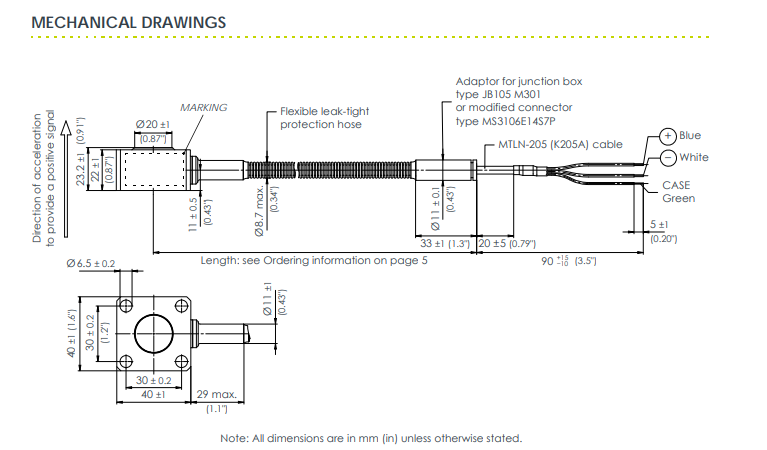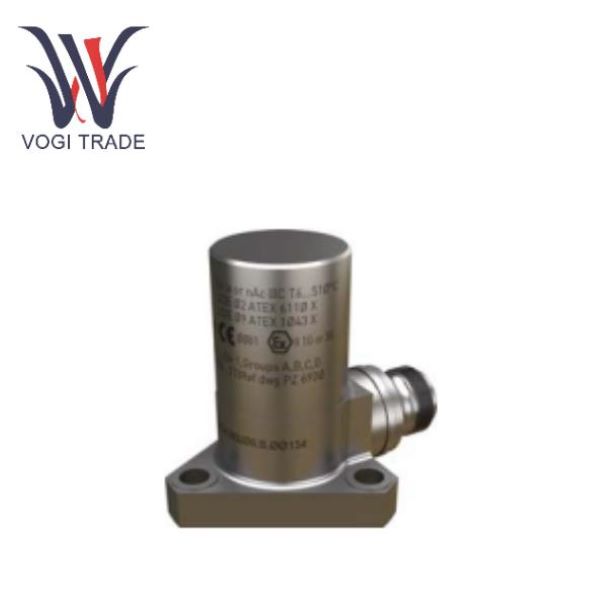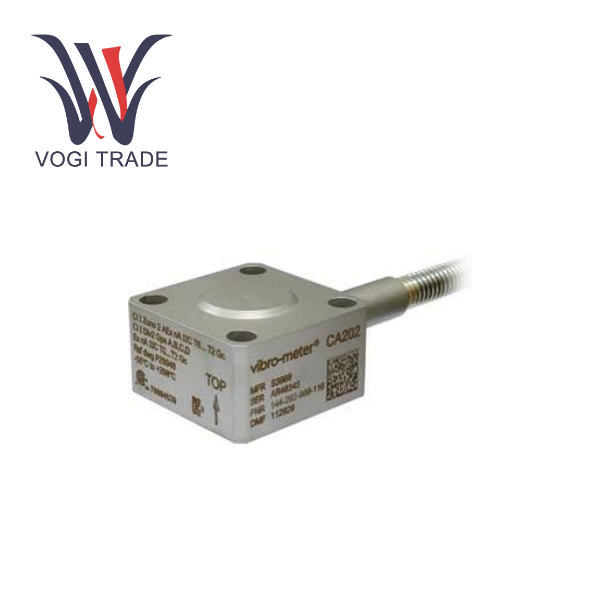
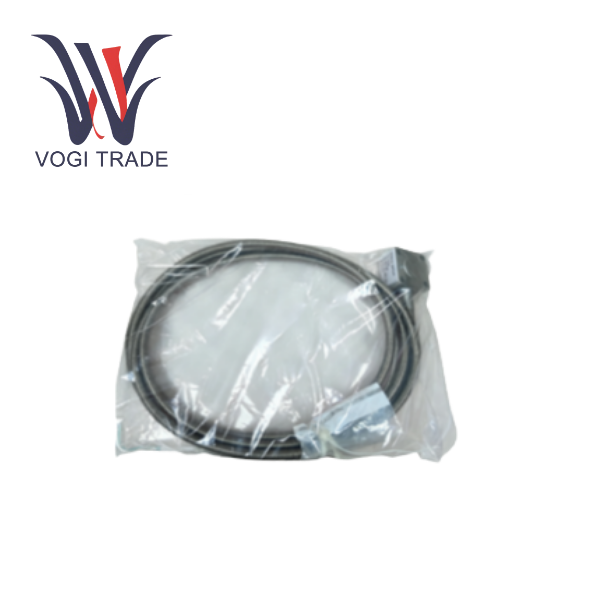
Brand: Vibro-Meter Description: Piezoelectric Accelerometer Condition: Brand New Certificate: TEST REPORT WARRANTY LETTER Warranty: 1 year Inventory Qty: 2 Payment Term: T/T Shipping Port: Xiamen CA202 144-202-000-126 is a high-performance, industrial-grade piezoelectric accelerometer from the VM product line. This specific model is a standard version equipped with an 11-meter integral cable, designed for continuous vibration monitoring in demanding but non-hazardous industrial environments.
|
Manufacture |
Vibro-Meter |
|
Model Number |
CA202 |
|
Ordering Number |
144-202-000-126 |
|
Catalog |
Vibration Monitoring |
|
Country Of Origin |
Switzerland |
|
HS CODE |
9033000090 |
|
Dimension |
16*16*12cm |
|
Weight |
0.6kg |
Product Overview
CA202 144-202-000-126 is a high-performance, industrial-grade piezoelectric accelerometer from the VM product line. This specific model is a standard version equipped with an 11-meter integral cable, designed for continuous vibration monitoring in demanding but non-hazardous industrial environments. Piezoelectric accelerometer embodies a robust, hermetically sealed construction that guarantees long-term reliability when exposed to moisture, steam, oil, and other corrosive contaminants. Utilizing a symmetrical shear-mode piezoelectric sensing element, the CA202 delivers high-fidelity vibration data critical for condition monitoring and predictive maintenance of critical machinery such as turbines, pumps, compressors, and fans.
The Difference between IEPE and 4-20mA Output - Taking CA202 as an Example
The signal types are different
IEPE outputs a dynamic voltage signal, retaining the complete original vibration waveform. The 4-20mA output is a static current signal, only transmitting the vibration amplitude converted proportionally.
The amount of information available varies
IEPE can extract rich data such as acceleration, velocity, displacement, spectrum, and phase. 4-20mA can only provide a single vibration amplitude, such as RMS velocity.
The anti-interference capabilities are different
IEPE requires the use of dedicated low-noise cables and has a medium anti-interference capability. 4-20mA has strong anti-interference ability and is the preferred solution for industrial sites.
The typical application scenarios are different
IEPE is suitable for fault diagnosis, spectrum analysis and scientific research; 4-20mA is more suitable for protecting downtime, trend monitoring, and integration with DCS or PLC systems.
Predict three characteristic frequencies of bearing failure through CA202 vibration data
The first type
Outer Ring failure Frequency (BPFO) The physical cause of outer ring failure is the pitting or spalling area where the rolling elements pass over the outer ring surface. In the spectrum collected by CA202, BPFO will exhibit distinct fundamental frequencies and their multiplications (such as 2x and 3x), and the amplitude is stable, basically unaffected by load changes. When the peak value of BPFO is 3 to 5 times higher than the baseline noise, it can be determined that early damage has occurred in the outer circle.
The second type
Inner ring failure Frequency (BPFI). The physical cause of inner ring failure is that the inner ring defect rotates along with the shaft, and the defect point repeatedly strikes the rolling elements. On the spectrum, modulation sidebands with power frequency intervals will appear near the BPFI frequency, and the waveform amplitude may vary with the fluctuation of the load. When the density of these sidebands increases, it indicates that the severity of the fault is on the rise.
The third type
Rolling element failure Frequency (BSF) The physical cause of rolling element failure is the appearance of flattening, cracks or spalling on the surface of the rolling elements. In the spectrum of CA202, BSF frequencies and their harmonics may appear, sometimes accompanied by the modulation of the rotation frequency of the rolling elements. The typical feature of this type of fault is that the vibration signal is intermittent and is greatly affected by the lubrication state.
Selection advantages (Why Choose 144-202-000-126)
Explosion-proof + High-temperature dual certification: The only universal accelerometer that simultaneously meets ATEX Ex ia and long-term high-temperature resistance of 260℃, suitable for dangerous high-temperature areas. High sensitivity + wide frequency: Capture 0.5Hz low-frequency vibration (such as slow rotation of a steam turbine) at 100 pC/g, and cover 6000Hz high-frequency (such as meshing frequency of a gearbox). Sealed and durable: Fully stainless steel sealed welding + armored cable, resistant to salt spray/dust/oil stains, suitable for harsh industrial environments. Long-term stability: Meggitt factory calibration, annual drift < 1%