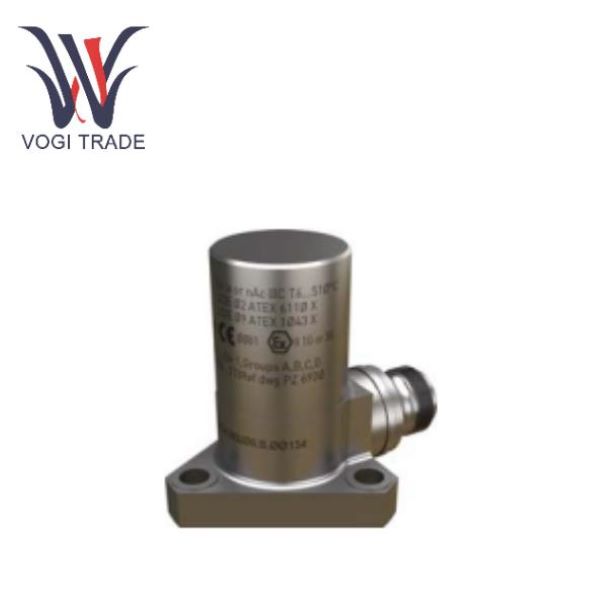
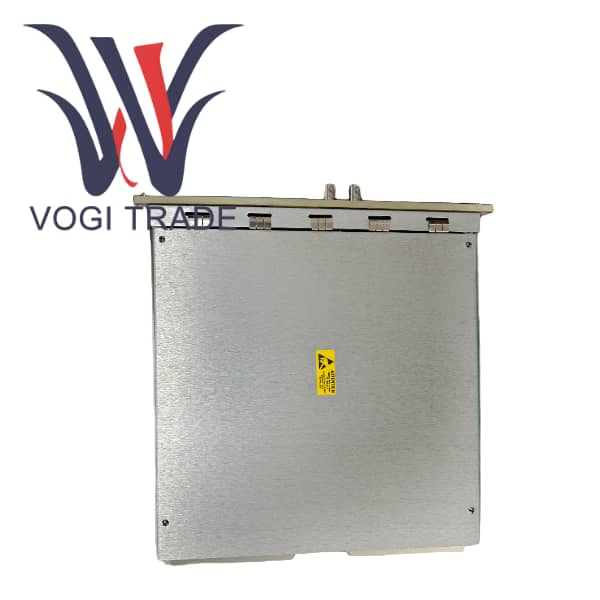
Brand: Vibro-Meter Description: signal conditioner Condition: New Warranty: 1 year Inventory Qty: 1 Payment term: T/T Shipping Port: Xiamen IQS900 204-900-000-011 A1-B21-C1-H05-I1 is designed for operation with vibro-meter TQ proximity sensors, that is, non-contact proximity sensors / measurement chains based on the eddy-current principle.
|
Manufacture |
Vibro-Meter |
|
Model Number |
IQS900 |
|
Ordering Number |
204-900-000-011 A1-B21-C1-H05-I1 |
|
Catalog |
Vibration Monitoring |
|
Country Of Origin |
Switzerland |
|
HS CODE |
8537109090 |
|
Dimension |
16cm*16cm*12cm |
|
Packing Dimension |
18cm*18cm*15cm |
|
Weight |
0.8kg |
Product Overview
The IQS900 204-900-000-011 A1-B21-C1-H05-I1 is a precise signal modem. The core function is to drive the TQ9xx series eddy current probes that come with it and process the tiny electrical signals returned by the probes. The coil at the probe head generates a high-frequency electromagnetic field under excitation. When this field acts on a conductive metal target (such as a rotating shaft), eddy currents will be induced. A slight change in the distance between the target and the probe will cause a change in the eddy current field, which in turn alters the impedance of the probe coil. The IQS900 precisely detects and demodulates this impedance variation, linearly converting it into a standardized analog voltage output signal, which directly and proportionally reflects the gap between the target and the probe. Specific model analysis (204-900-000-011 A1-B21-C1-H05-I1) :
A1 The environmental version is "Standard Type", suitable for non-hazardous (non-explosion-proof) industrial areas.
B21 Core performance parameters are defined. B21 represents a linear measurement range of 2 millimeters, with an output in voltage mode and a sensitivity as high as 8 mV/μm. This means that for every 1 micron the target moves, the output voltage changes by 8 millivolts, providing extremely high displacement resolution and measurement accuracy, making it particularly suitable for monitoring minute vibration changes.
C1 The diagnostic function is "Without diagnosis". This is an economical basic version that does not have the built-in (BIST) self-check function and cannot automatically indicate sensor or cable faults remotely.
H05 The total system length is configured as 5 meters. This specifies the combined total length of the matching probe integrated cable and extension cable to ensure the optimal electrical performance and calibration accuracy of the entire measurement chain.
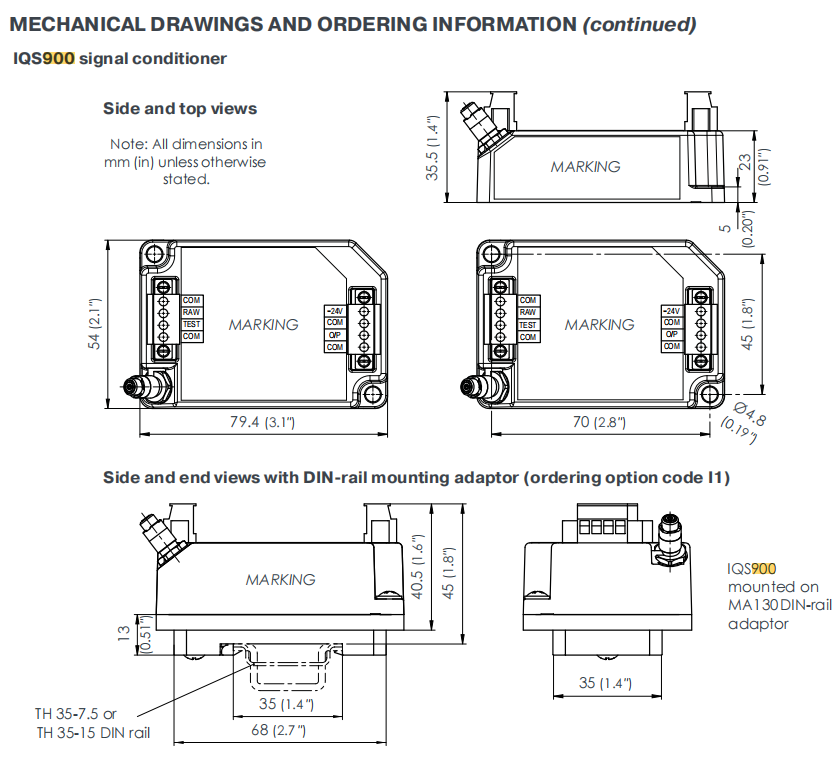
I1 The installation method is "with DIN rail adapter". The product comes with the MA130 installation kit, which can be directly installed on the standard TH35 DIN rail, greatly simplifying integration and wiring within the control cabinet.
specifications and parameters
Product Functional Features
Low-impedance voltage output ensures excellent signal fidelity and system compatibility
The powerful load driving capability can be achieved with a DC output impedance of less than 100Ω, enabling it to easily drive long-distance cables and directly connect to various data acquisition systems, isolation barriers or safety barriers without worrying about signal attenuation.
Simplifying system integration and modification, excellent impedance characteristics enable IQS900 204-900-000-011 A1-B21-C1-H05-I1 to be compatible with most third-party signal isolators or intrinsically safe barriers on the market, with minimal signal loss (for example, when connected to an isolator with a 10 kΩ input impedance, the maximum signal loss is only about 1%), reducing the complexity and cost of system integration.
The convenient on-site test interface facilitates rapid debugging and maintenance
The original signal monitoring point, with an independent RAW/COM output terminal, enables maintenance personnel to directly detect the signal quality from the probe to the input end of the regulator without interrupting the main measurement circuit, quickly locating sensor or pre-cable faults.
The simulation TEST injection function. The TEST/COM input terminal supports the injection of known test signals, which will flow through the entire amplification chain of the conditioner and appear at the main output terminal. This function can independently verify whether the signal conditioner itself and the back-end path connected to the upper-level monitoring system are working properly, achieving "segmented" fault detection and significantly reducing the downtime for debugging.